
Metaverse Learning Highlights of the Department of Information Communication Building an Interactive Art Creation Corridor with AR Applications
With the rise of Big Data, Artificial Intelligence (AI), and the Internet of Things (IoT), context-aware technologies and smart system applications have influenced many aspects of media communication and created new opportunities for smart communication infrastructure. In this rapidly changing era, the Department of Information Communication at Asia University builds on its foundation in smart media development by integrating curriculum design with hands-on practice at the Smart Communication Media Center. This approach strengthens students’ ability to connect learning with practical application and cultivates a new generation of media professionals equipped with smart communication technologies as well as literacy in journalism, film, and television.
In response to the rapid advancement of information technology and the increasingly powerful engines used for virtual film and television production, the Department of Information Communication at Asia University has consistently remained at the forefront of communication technology. In line with the continuous evolution of AR/VR technologies and equipment for immersive experiences, together with the decentralized transmission mechanisms enabled by blockchain technology, the Department’s teaching and distinctive development initiatives focus on realizing metaverse concepts and transforming creative ideas into immersive experiences.
Asia University President Chin-Fa Tsai notes: The most important aspects of education are stimulating students’ motivation and interest in learning, designing effective instruction, and creating engaging learning environments. Immersive learning made possible by the metaverse transforms learning into a novel experience, strengthens students’ sense of presence, interaction, and participation, and inspires their imagination and creativity.
In addition, the metaverse enables knowledge resources to be reused, helping reduce the cost of education. For example, within a metaverse environment, digital avatars of Nobel laureates could enter classrooms and interact with individual students, while historical figures could be recreated in the present day, overcoming the limitations of time and space. Through the sharing of digital resources, the metaverse may also help reduce educational resource disparities caused by socioeconomic inequality and support educational equity under the United Nations Sustainable Development Goals (SDGs). For the transformation of education in the 21st century and the sustainable development of humanity, the metaverse may become an important driving force.
 Click to Enlarge
01
Click to Enlarge
01
 Click to Enlarge
02
Click to Enlarge
02
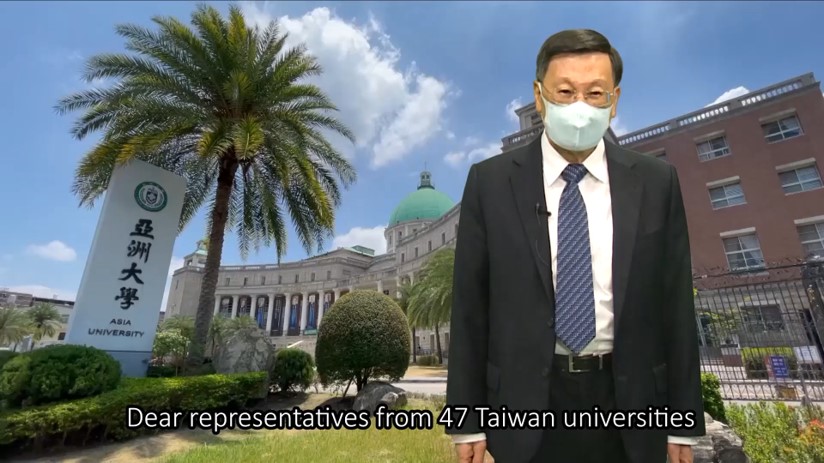
▲ Caption: President Chin-Fa Tsai emphasizes that the metaverse opens unprecedented possibilities for education.
Accordingly, Shih-Nung Chen, Chair of the Department of Information Communication, uses the Asia University campus as an example to integrate AR and AIoT (AI + IoT) technologies. Virtual objects are created for use on mobile devices or AR glasses to generate context-aware AR applications, enhancing situated learning within smart environments and supporting the acquisition of domain-specific knowledge.
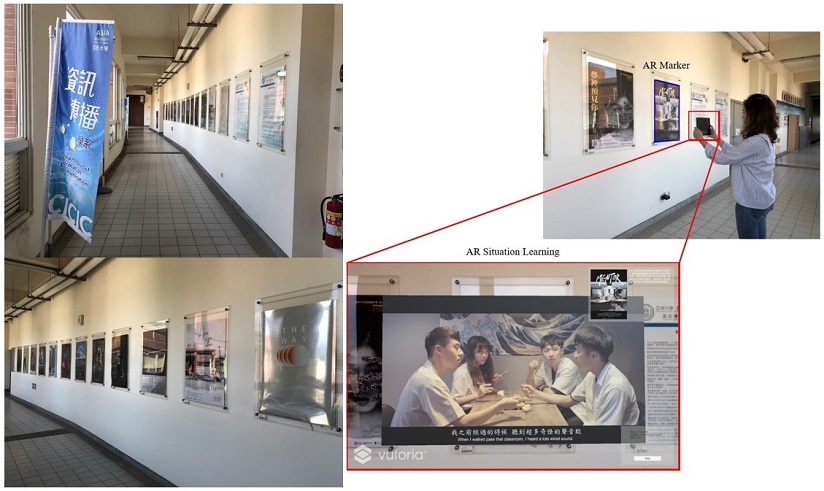
Chair Shih-Nung Chen first uses the Department’s Interactive Art Creation Corridor and the smart campus as experimental settings to develop a context-aware learning system for the smart campus. The system incorporates physical spaces and objects such as student film and television projects, IoT-based interactive artworks, paintings, and sculptures, while integrating digital content exhibitions and guided-tour functions. Its purpose is to create an adaptive and interactive context-aware learning environment for the smart campus, with in-depth research and practical implementation focusing on next-generation human–computer interfaces, context-aware technologies, and the development and application of the metaverse and digital twins. Real-world applications are used to evaluate feasibility and learning effectiveness.
 Click to Enlarge
03
Click to Enlarge
03
Integrating AR technology into situated learning can stimulate learners’ motivation and enthusiasm. By using mobile devices or AR glasses to scan capstone project posters displayed in the corridor, students can view promotional videos and detailed learning portfolios for each project through AR. The same technology can also be applied to teaching, journalism, film, magazines, books, encyclopedias, advertising posters, trademarks, virtual signage, online shopping, and other next-generation human–computer interfaces and smart communication applications.
Faculty and students of the Department of Information Communication are actively developing learning environments based on metaverse concepts while researching the production of digital materials and the creative implementation of both hardware and software. Current pilot testing focuses first on physical sculptures across the campus and the Department’s Interactive Art Creation Corridor, with plans to gradually expand these applications throughout the campus.
Image
1 / 3