Quick Navigation
Department Mission
In response to current trends in information technology and communication technologies, the Department is committed to cultivating professionals with expertise in online communication technologies, digital content creation, and the integration of communication technologies.
Educational Objectives
- Cultivate well-rounded, caring, innovative, and outstanding professionals
- Develop professionals with core information technology competencies
- Develop professionals in new media creative production
- Develop professionals in new media communication technologies
- Develop professionals in new media planning and marketing
Core Competencies
Bachelor’s Program Core Competencies
- Ability in information and media communication: professional communication ethics and logical thinking in communication
- Ability in information and media design: website production, visual creation, animation design, and video production applications
- Ability in information and media analysis: digital media analysis and marketing planning analysis
- Ability in information and media applications: integrated development of software and mobile device applications
- Knowledge and technical ability to integrate communication technologies, marketing planning, and creative production
- Ability to communicate effectively and collaborate within teams
- Ability to acquire new knowledge in information communication and respond to emerging trends in the field
- Professional ethics, humanistic literacy, and social responsibility
Master’s Program Core Competencies
- Independent Research: Capacity for self-development and lifelong learning
- Academic Paper Analysis: Ability to read, comprehend, analyze, and write academic papers
- New Media Creative Production: Practical and research ability to analyze and apply the characteristics of new media in creative production
- New Media Communication Technologies: Practical and research ability to analyze and apply the characteristics of new media in communication technologies
- New Media Planning and Marketing: Practical and research ability to analyze and apply the characteristics of new media in planning and marketing
Development Features
- Develop students’ ability to integrate technologies for information media and digital content communication
- Integrate communication media, information technology, and perceptual design within the curriculum
- Cultivate high-quality information communication professionals with cultural awareness, forward-looking perspectives, and international competence for the digital age
- A diverse, international, and practice-oriented faculty
Research Areas
Digital Content Development | Media Transmission Technologies | Innovative Application Integration
Curriculum
Bachelor’s Program
- Foundation Courses: Including programming, web design, visual media, photography, animation, digital marketing, and related subjects
- Professional Elective Programs:
- Smart Communication Applications Program: Covers the development of information and audiovisual platforms (websites), integrated audiovisual content production, and applications in new media, AR/VR, the metaverse, and virtual interactive devices
- New Media Communication Content Program: Covers the production of short films, narrative films, documentaries, animation, advertising, planning, and analysis
- Interdisciplinary Program: Smart Multimedia and Cultural Creativity Program (News Media and Communication)
- Total Credits Required for Graduation: 128 University-required courses: 30 credits + college core courses: 12 credits + department core program: 36 credits + major program (professional elective program): 27 credits + other non-major professional elective programs, interdisciplinary programs, or free electives
Master’s Program
- Total Credits Required for Graduation: 27 Master’s thesis: 3 credits (may alternatively be replaced by a technical report or performance/exhibition) + Thesis Seminar: 2 credits + Special Topics Seminar: 2 credits + Research Paper Writing: 2 credits + Free Electives: 18 credits
Major Laboratories and Facilities
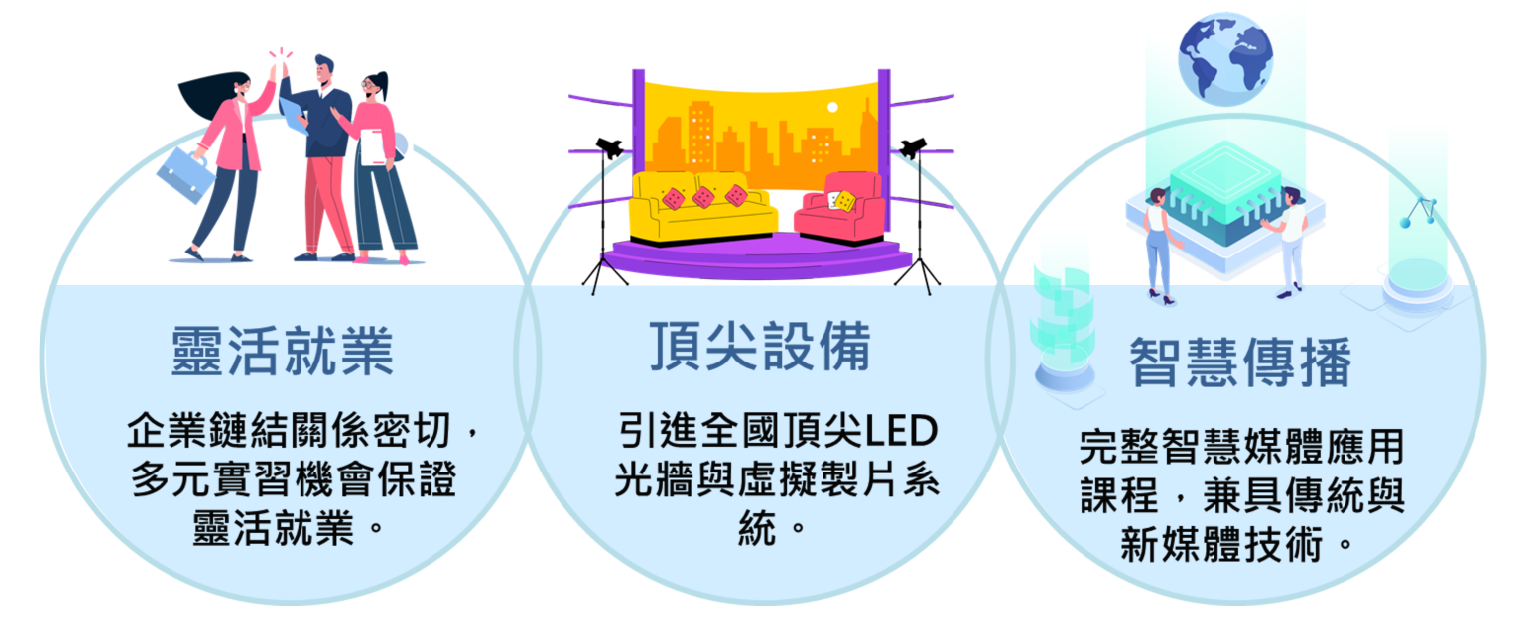
- Professional teaching facilities include high-performance multimedia computers, projectors, scanners, graphics tablets, MPEG-2 hardware encoders, webcams, digital video cameras, digital cameras, and a high-definition (HD) virtual studio.
- Professional teaching software covers digital image processing, computer graphics, interactive web design, 3D computer animation, animation effects, digital video editing, digital sound design, multimedia integration, programming, and related applications.
- Professional laboratories include the Project Production Laboratory, Digital Audio-Visual Engineering Laboratory, Media Analysis Laboratory, New Media Creative Production Laboratory, and New Media Communication Technology Laboratory.
Practical Learning Program
- A one-year Capstone Project course
- A 7+1 internship program, allowing students to spend the second semester of their senior year in a six-month industry internship
- Comprehensive internship opportunities, including off-campus internships or placements at the University’s Digital Media and Teaching Center
- Participation in industry–academia cooperative internship programs and employment-oriented programs
Career Opportunities
News and Media
Collect and verify information through investigative reporting, interviews, and other methods; organize findings and produce complete reports for newspapers, magazines, radio stations, television stations, and other media outlets.
Media, Advertising, and Public Relations
Build brand image and assist clients in selecting advertising media, time slots, channels, publication placements, and dates while carrying out creative marketing, planning, and campaign execution.
Digital Marketing and Content Creation
Develop product marketing strategies, pricing strategies, promotional plans, marketing proposals, and content to help organizations strengthen their market competitiveness.
Film, Television, and Advertising Production
Work in television, film, advertising, and audiovisual production as screenwriters, directors, producers, video editors, and related professionals.
Interactive Communication Technology
Develop next-generation AR/VR immersive applications, interactive multimedia, websites, digital media projects, and multimedia database systems.
Photography and Visual Production
Operate cameras, video cameras, the LVS studio, and virtual production systems for portrait and product photography, television production, radio recording, and video recording.
Other Information Technology Professions
Pursue careers in information technology, human-computer interaction, generative AI applications, user interface design, social media consulting, digital marketing consulting, and related fields.
Frequently Asked Questions